Showing posts with label Picture Post. Show all posts

Friday, 31 October 2014

Women In Wartime - ARC Clubmobile


Women In Wartime - American Red Cross ClubmobileA few months ago I had to write a post for my works' blog to promote a special model we had created of an AEC 10T10 bus, decorated in a grey wartime livery for the American Red Cross, for use as a Clubmobile.

To make the post a little more interesting than just a list of facts, I decided to embellish the history with a few images of a Clubmobile in action, and this was how I stumbled across the subjects of today's post. I'd found a wealth of images in the Life Archive, about one Clubmobile unit called 'North Dakota'. I knew instantly that though the bus enthusiasts would probably not appreciate a post about these ladies (and gent) that perhaps you all would, and so I have spent the last few weeks trying to find out more about the North Dakota Clubmobile & her staff.


But first a bit of History... In 1942 the US Armed Forces asked the ARC (American Red Cross) to create a recreational retreat for its servicemen, who were stationed at various bases across Europe. In England, ARC Service Clubs were set up in towns near to where American Forces were stationed and soon after Areo Clubs were created on air bases. Usually these services were offered for free to its servicemen, but due to the discrepancies in pay between the American Forces and their British counterparts (the British servicemen had to pay for the food at their service clubs), the US secretary of war asked the ARC to charge for its services, though prices for food were kept to a minimum.
Women In Wartime - American Red Cross Clubmobile
(Image Source)


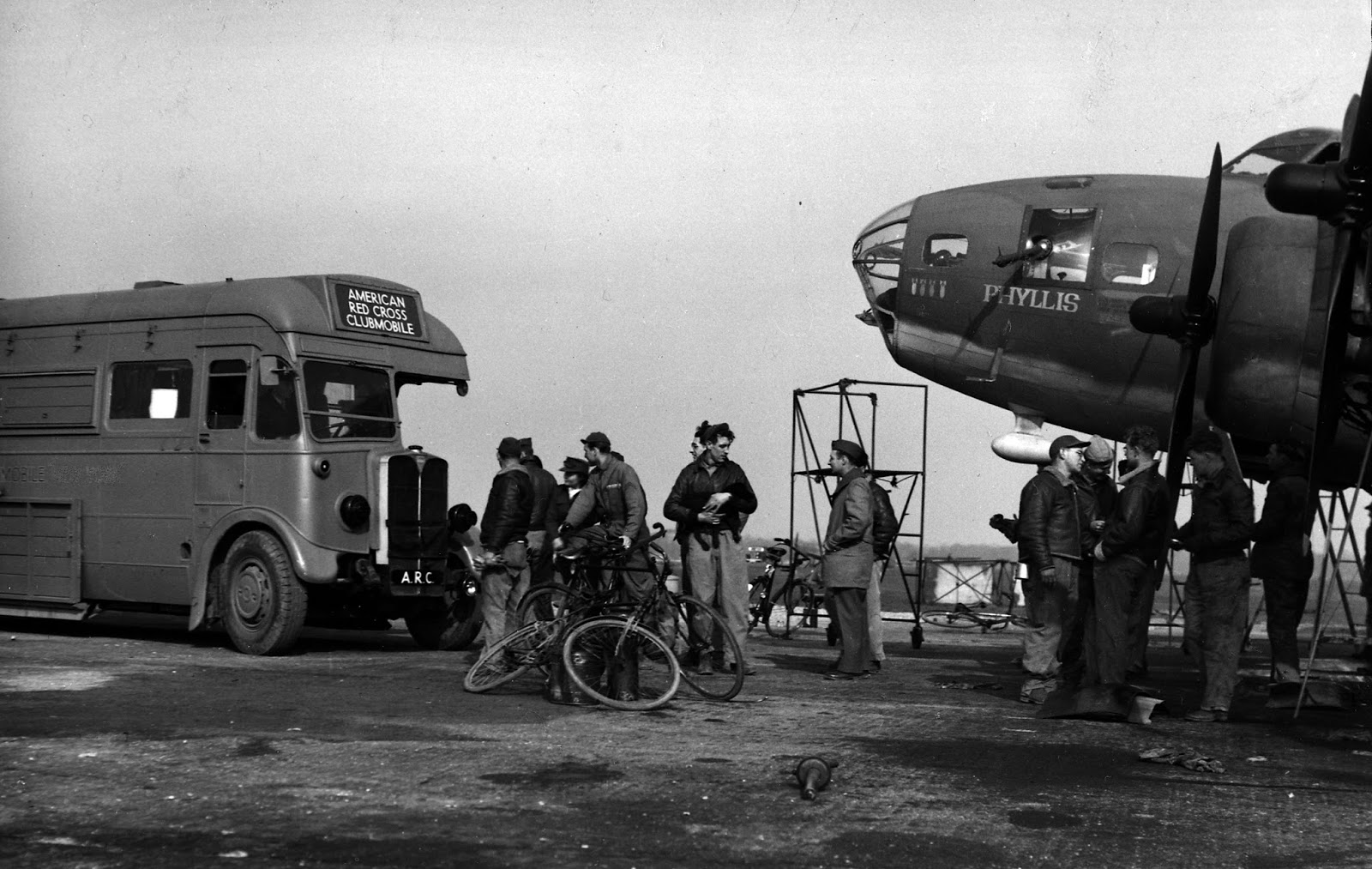
The Clubmobile was conceived by ARC Commissioner to Britain Harvey D. Gibson. His plan was to put a service club "on wheels" which would be able to reach the serviceman directly at their camp or airfield, also by having a mobile club the ARC was able to get around the Forces request that a charge had to be made for their food and so were able to dispense their home comforts for free. In Britain Clubmobiles were created from buses loaned to the ARC by London's Green Line Bus company, they were ideal for the job as they were quickly and easily modified in to mobile kitchen units, with the addition of offside dispensing hatches and the rear could be converted in to a  a lounge with built-in benches which turned into bunks if needed. Every vehicle was given a name (mostly they were named after U.S. State's) contained a built-in doughnut machine and a primus stove for heating water for the all important American coffee. On board there was a Victrola record player with loud speakers for blasting out the latest tunes from back home, paperback books, magazines, cigarettes, candy, gum, and most importantly they brought the GI's, a little taste of home.

Women In Wartime - American Red Cross Clubmobile
Each unit was crewed by three 'Glamorous' young American women (though the North Dakota has four) and was driven to each location by a British driver. They were stationed in a town near American Forces installations and followed a routine of going to different bases each day where they would talk to servicemen while they served coffee and doughnuts and played their music loud, and chatted to the men, giving them a much-needed morale boost.

Women In Wartime - American Red Cross Clubmobile
The Glamorous American crew of the 'North Dakota' Clubmobile


These young women were recruited by the ARC from all over the United States, they were required to be between 20 and 35, to have at least some college education and previous work experience. In addition they had to be "physically hardy" sociable and attractive. On arriving in England they would be taken to London to be given the training in the skills they would need out in the field, essentially how to turn out dozens and dozens of doughnuts a day, an article from The Milwaukee Journal dated Sep 21, 1943 gives us a fuller picture of this training and the effect these 'Glamour girls were having on their British cousins.
In the Basement of one of London's Ancestral homes, in the heart of Mayfair, a doughnut school has been set up. Here pretty girls newly arrived from the states learn how to turn out doughnuts for the troops at the rate of 840 an hour. They wear white overalls and are easily the loveliest Army that has ever visited England. There are nearly 500 American girls in the country working for the ARC which runs the doughnut school. They are helped by more than 6,000 British volunteers. No task is to great or small for these girls to tackle. Some teach American troops London Ballroom dancing and other hold daily shorthand classes for US sailors. 
....There are no beauty bans in this service, and all the girls look glamorous with their silk stockings, varnished nails and elegant footwear. The British ATS, WAAFS and WRENS, look drab in comparison, with their Khaki, Air Force blue uniforms and black Lisle stockings, heavy shoes, little make up and no nail varnish. These American girls have caused a great impression on what is left of the British men in England. When the American troops first arrived in this country most of the English girls went crazy. Every American to them was a potential film star. Their unusual drawl and carefree manner captured numerous hearts. Their generosity and love of simple things endeared them to the hearts of the English mothers and Fathers. 
For a time Englishmen took second place, now things are different. American girls with their alluring accents, trim well cut uniforms, lovable natures and untiring zest for work and play have caused the English 'Tommy' a terrific heart throb. One English Officer said of them "they are so natural, so down to earth, you feel you are talking to a man until a whiff of that glorious perfume they all seem to wear reminds you that these are not ordinary women. These are brave women who have crossed dangerous waters to be of help to us here....When asked what this allusive perfume was, the girls said: " Its toilet water you get back in the states, you can't wear a heavy perfume in uniform, and this toilet water seems to fill the gap. These American girls have really made their British sisters sit up and take notice. Even the hairstyle have altered, and once again the age old argument is raging in the feminine forces, as to why they can't have their nails red, wear silk stockings and reasonable shoes. (Source)
It seems it was not just the American GI's who these ladies made a morale-boosting impact on, they were making the war-weary British Tommy's hearts beat a bit faster too. Though no doubt they made the 'drab looking' British service women, who for years had been restricted from any form of beautification whilst in uniform, just a tad jealous!

OK, history bit is done, I think it's time for me to introduce you to the North Dakota's crew.


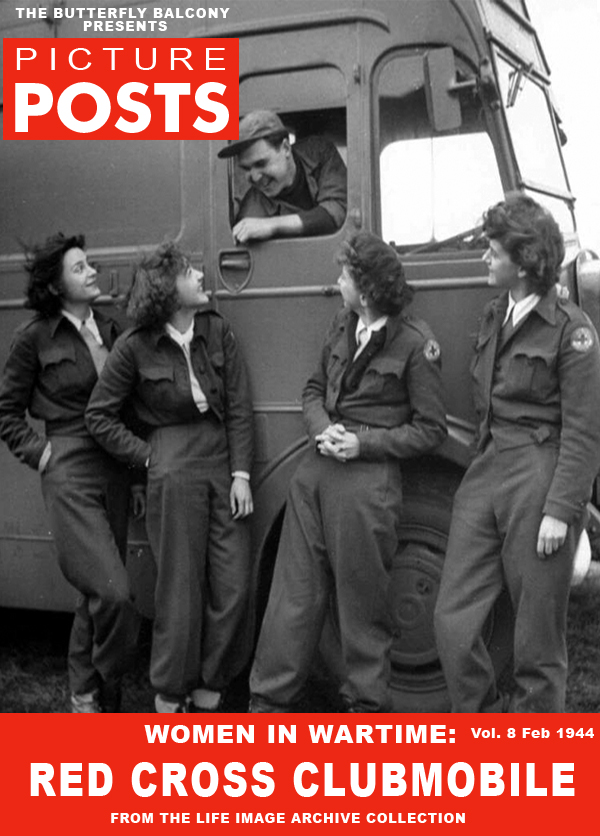
Left to right : American girls Tatty, Mike, Dooley & Ginny discuss the day ahead with their English bus driver Fred


So we've met the team, lets now look at what a typical day aboard a Clubmobile entails. Life did an article on this Unit in February 1943 and after much searching, I have managed to track down an actual copy of the magazine which has helped immensely to piece everything together.

Life Visits Red Cross Girls in England
Their job on the fighting front is romantic, but their days start at dawn and the work is never done

Somewhere in England, four American Red Cross girls staff a Clubmobile bus, one of 51 such mobile canteens operating in the British Isles.
Ginny is mixing the dough for the first batch

The girls are up and at 'em bright and early well before dawn, to make the first batch of the vast quantities of doughnuts that the will need for the day. The Girls take turns in getting up at 4.30 am to make the doughnuts and are all out on their rounds by 8.30 am.

Tatty emerges from the Clubmobile, with a rack full of the freshly made 'sinkers'
Once they are ready they head off to their first port of call for the day. Today's first stop is an American Airbase 'somewhere in England'. As they approach the base the girls put on a record and blast the music from the loudspeakers mounted front and back of their bus.


At each stop, the girls are greeted with howls of delight, and the boys throng to the bus from runways, hangars and trucks, forming long queues all eager to get their coffee and doughnuts and a glimpse of an 'All American Gal'.


A happy Sergeant grins and greets the girls "seen ya' comin' a mile away"
Whilst Ginny and Dooley handout the food Mike and Tatty chat to the GI's. After many weeks of regular visits the girls know most of them by name. Their slogan is "doughnuts will win the war".

“She’s a perfect 42, fellas,” this mechanic teases Mike as the boys measure her waist.
Tatty is deep in conversation with some friendly GI's
Dooley and Mike lark about with a jolly kitchen assistant
The Red Cross girls come in for a lot of good-natured kidding from the servicemen, with whom they become quite friendly.


While the girls are occupied entertaining the troops, Fred takes the opportunity to give the bus a quick once over, he manages to impress the girls daily with his ability to manoeuvre the bus out of a tight spot or two!


Once all the coffee and doughnuts have been served its time to refill the urns by creating a train from the mess hall to the Clubmobile, these 8 urns manage to hold 40 gallons of Coffee!


Next stop for the Clubmobile is a field hospital where the girls dispense the last of the doughnuts and coffee and spend time chatting and reading papers from back home to the patients, before heading back to their billet.


Back at their billet, which is a wing of a large 15th century mansion owned by an English Earl and his Countess, its time to change into there dress uniform ready to attend a party!


The evening is filled with jazz music and dancing though girls are cautious not to have too much fun as their enlisted friends are hurt if they date officers too often!


After a night of dancing and fun, the girls have a quick chat about the night before bed and before their next day in charge of American morale.

 ~ ~ ~ ~ ~ ~ ~ ~ ~ ~ ~ ~ ~ ~ ~  ~ ~ ~ ~ ~

It was bugging me for a while that I couldn't figure out where in England this team were stationed, 'somewhere in England' is all the article unhelpfully said, but thanks to my day at IMW Duxford a few weeks back I spotted that the aeroplanes pictured at the airbase are B17's and by searching the tail number shown in the below picture, I discovered a bit of helpful information.


I found this snippet of information:
The B-17F salvaged on May 20, 1944 due to battle damage. It was a B-17F built by Douglas-Long Beach and delivered to Denver on June 23, 1943. From there it went to Dow Field and then on to the 96BG/338BS at Snetterton. Apparently, it was given two nicknames: Hell's Chariot and Wacky Woody.
Which suggests to me that the photos were taken at the Snetterton airfield (which has now been turned in to a race track) if this is the case it would mean the team was stationed in Norfolk.

I have also managed to track down a little information about our team and what happened to them after this day back in 1943.

Katherine 'Tatty' Spaatz

Age 22, “homeless” daughter of the Air Forces from Washington D.C.
Katherine Arrived in England along with socialite Katleen Kennedy and 52 other volunteers in July 1943. Daughter of Lieutenant General Carl Spaatz, commander of US strategic Air forces in Europe. She worked with the ARC Clubmobile unit for 2 years, initially working in England and later, after the invasion of France. By July 7th 1945 she was back in the states with her parents in Miami. September 1948 the Milwaukee Journal reports she has married Walter F Bell of Sussex, England

Julia 'Dooley' Townsend
Age 28, from New York City
Not much can be found out about Julia the only reference I can find is that she is still working with Katerine Spaatz by August 1944, they are both now working in France, still serving out doughnuts and warm wishes.

Virginia 'Ginny' Sherwood

Age 24, from Portland Oregon
Ginny was the Captain of the crew and niece to Officer of War information Robert Sherwood. She is also to be found working with Tatty and Dooley in France 1944.

Dorothy 'Mike' Myrick

Age 24, Whiting, Indiana
Before joining the ARC as a teen she was very much into acting and by accounts rather good, as a reference to an Indiana newspaper for 1936 states:

"Dorothy Myrick will present the Globe Theatre version of Shakespeare's "The Comedy of Errors," at the Congregational church tomorrow evening at eight o'clock. Those who saw the Whiting Juvenile Theatre Guild presentation of "A Midsummer Night's Dream," under the direction of Miss Myrick, know what a treat they will have tomorrow evening"

The only other info I have found is a reference to her marrying a teacher by the name of Steve Randal in 1950, they had three children together (all girls) and she died in 1999.

Fred Clark

27, East end of London England
Fred was invalided out of the Royal Navy and became a bus driver for the ARC, and the only one of the gang not to be an American, though the girls accuse him of acquiring a Brooklyn accent!
If you made it this far I salute you! If you enjoyed this post you can read more about women of the Clubmobile below, or if you fancy looking through some my past Picture Posts click the tab at the top!

Further Reading:

Wednesday, 30 October 2013

The Home Front – Blackout Accessories

The clocks went back by an hour this weekend here in Blighty, which meant a lovely extra hour snuggled up in bed, sadly it also means as much as I hate to concede to it, the gloaming wintery nights and dreary early mornings will gradually be drawing themselves tighter around us over coming weeks, so I thought it would be the perfect time for  another Picture Post from the Imperial War Museums archive collection. This time, we are going to take a glimpse at what life was like during the wartime blackouts and see what precautions people could take to keep them safe and sound in the blackness.

Preparations for war had begun as far back as 1937 the Air Ministry predicted that if war was declared, Britain would be subjected to sudden night air attacks from Luftwaffe bombers, which would lead to high levels of civilian casualties and mass destruction to towns and cities. To counter this threat the government decided that if all man-made lights were extinguished, this would mean that the enemy who was identifying their targets using pre-war maps and up to date reconnaissance photographs would find it much more difficult to hit their intended targets as any identifying landmarks would be shrouded in the blackness. Blackout rehearsals became routine from early 1938, householders were told to check their homes for chinks of light while the RAF monitored the areas from above, these test showed that vehicle traffic was the main problem, even vehicles driven with just sidelights were still clearly visible from above and highlighted the road pattern below.
(Image Source)
To achieve this nationwide blackout it was necessary and a patriotic duty for every citizen to play their part. Ensuring that the rules were strictly followed was vital, so the home office appealed for 300,00 ‘citizen volunteers’ to be trained as A.R.P wardens to enforce the rules and impose fines to those who did not comply. So at sunset on the 1st of September 1939 two days before the official outbreak of WW2  the UK was plunged into complete utter darkness.


(Image Source)
Street lamps were extinguished, homes were fitted with blackout curtains and paint to ensure that no ambient light escaped from chinks in their windows, trains were fitted with dingy blue lights which made it barely possible to see your fellow passengers and because the stations were also blacked out it became increasingly difficult for passengers to determine firstly what station they were at, and secondly, which side of the train they need to alight to actually step on the platform. On the roads, vehicles were permitted to use lights as long as they were properly  covered with a metal hood, which only allowed thin slits of light to shine upon the approaching road and even the amber glow from a cheeky night time cigarette was banned. The people did what they were told and ‘put that light out’!


(Image Source)
A consequence of the new blackout regime was that road traffic incidents increased dramatically, so the government decreed that thick white lines must be painted on kerbs and lamp posts, but this proved to make little difference to the number of collisions. It's interesting to note that by the end of 1939 a mere three months into the war, a reported 4000 civilians had been killed in blackout related accidents, a sobering thought when during the same period in combat only 3 of the British Expeditionary force had been killed in action. In the Jan of 1940 the government relaxed the laws and allowed low powered torches -as long as the were covered with 3 layers of brown paper with a hole the size of a half-penny cut in the middle allowing only a tiny beam of light – to be used to hail buses by shining the torch on to you palm or feet, however, batteries supplies soon became scarce so eventually even this was no longer an option.

To make people feel a little safer during the blackouts the government urged pedestrians to ‘wear something white at night. Policemen were issued with white capes and shops had a run on white coats and macs as well as other accessories and it is at one such shop that we pick up today's Ministry of Information story at the ever so stylish blackout counter in Oxford Streets Selfridges.
A sales assistant, using a stuffed toy, demonstrates a blackout coat for dogs to a customer at Selfridge's department store in London. The coat would make sure that the dog was visible to car drivers and pedestrians during the dark nights of the blackout.
A female sales assistant helps a customer to choose a blackout collar at Selfridge's department store in London.The various styles available were an attempt to make the functional collars a bit more fashionable. The collars would help to ensure that the wearer was a bit more visible to cars and other pedestrians in the blackout.
A blackout walking stick on sale at Selfridge's in London's Oxford Street.
The light in the tip of the walking stick would illuminate the ground sufficiently for the user to see more clearly in the blackout, and to make the user more visible to pedestrians and vehicles. These walking sticks sold for 14/6.
A woman pins a luminous disc to her jacket lapel at Selfridge's department store in London.
These badges were to be worn in the blackout, as a way to make the wearer more visible to fellow pedestrians and motorists on the dark streets of the blackout. These discs were on sale for 2d per dozen.
A female shop assistant displays a white raincoat for use in the blackout. The colour of the fabric of the coat would mean that the wearer would be clearly visible to other pedestrians and to motorists in the dark streets of the blackout.
A display at Selfridge's department store in London advertises the various accessories available for use in the blackout.  Included here are two types of luminous armband, luminous discs and button badges, and luminous adhesive tape which could be added to the edges of clothing. The aim was to make the wearer more visible to pedestrians and vehicles in the blackout
A stand at in the umbrella department of Selfridge's department store in London displays a selection of blackout walking sticks.  These sticks were painted with luminous paint to make the user more visible to pedestrians and motorists on the darks streets of the blackout. These sticks sold for 2/6 each.
A luminous gas mask case on sale at Selfridge's department store in London. These gas mask covers were on sale for 2/11.
A woman pins a luminous flower onto her jacket lapel and consults her reflection at Selfridge's department store in London. These flowers were prettier than the plain button badges and luminous discs that were also available but did the same job: making the wearer more visible to other pedestrians and motorists on the dark streets of the blackout.
A woman looks at her reflection in a mirror as she examines a selection of blackout collars at Selfridge's department store in London. The various styles available were an attempt to make the functional collars a bit more fashionable. The collars would help to ensure that the wearer was a bit more visible to cars and other pedestrians in the blackout.
A shop assistant shows a customer a luminous flower in Selfridge's department store, London.
These flowers were one of numerous blackout accessories available in 1940 to make pedestrians more visible on the dark streets of the capital.
At first people avoided going out at night, but once the winter drew in and the days became shorter it was harder for people to avoid, life must have been extremely difficult for those who had to navigate the streets at night, even with your snazzy new collar or illuminated cane, I don’t think that I would have felt much more at ease at all, it must have been quite an eerie let alone dangerous time, not only did you have the dangers in the dark to contend with there was also the little matter of the bombs!
~~~~~~~~~~~~~~~~~~~~~~~~~~~~~~~~
In case you fancy your very own blackout accessories, I have the perfect pattern for you taken from Home Notes November 1942, are these 'Safety First Gloves'. Knitted in a striking navy blue and white  combination, these snazzy gloves will ensure that you are not overlooked in a blackout!


Be safe, be seen!
Wendy x

Sunday, 7 July 2013

Women in Wartime - A Girl Joins Up

Today it's time to give you another Picture Post from the Imperial War Museums archive collection.


The coming of WW2 saw a change in what society perceived as acceptable roles for women. Up until the war 'women's-work' had mainly been secretarial or shop work, training was generally not given as their job was considered to be only temporary, women were expected to leave work once they married, or had their first baby.

With the tide of men leaving, called on to join the armed forces, Britain was left with a huge labour shortage, these jobs needed to be filled and quickly, so where better to look, than the previously untapped workforce of women. The government assumed that women would naturally move into 'essential work' as they had during WW1, but by early 1941 there was actually an increase in unemployment amongst women. So for the first time in history, the government made it compulsory for women to enrol in ‘useful war work’. From April 1941 all women had to register at their local Employment Exchanges, and those aged  between 18 and 40 (later extended to 50) would be destined for war work. These jobs could be within the area where they currently lived, or in some cases when travel was too expensive relocation was necessary, it all depended on their 'Household Responsibilities'.

The Butterfly Balcony - Picture Posts - A Girl Joins Up - Women in Wartime

It is from the Governments Employment Exchange that we start today's photographic journey. Today we are following Vera Elliot, a young mother from Sunderland, as she responds to the call and takes part in a Government Training Scheme and is placed in factory work.

The Butterfly Balcony - Picture Posts - A Girl Joins Up - Women in Wartime
Vera Elliott volunteers at her local employment exchange for work in a war production factory. The employment officer gives her an introduction card to a factory needing new recruits.
The Butterfly Balcony - Picture Posts - A Girl Joins Up - Women in Wartime
Vera Elliott kisses her daughter Heather goodbye at Sunderland railway station as she sets off to start war work elsewhere in Britain, while her foster mother Mrs Smith looks on. Behind them, a soldier and several women wait to board the train which can be seen behind them as they stand on the platform.
The Butterfly Balcony - Picture Posts - A Girl Joins Up - Women in Wartime
Vera Elliott says goodbye to her daughter Heather and her foster mother Mrs Smith from the window of a train as she sets off from Sunderland railway station to begin her war work
The Butterfly Balcony - Picture Posts - A Girl Joins Up - Women in Wartime
At the entrance to Birmingham New Street railway station, Vera Elliott stands with other new arrivals for factory work as they are split into groups, with each group being sent to a different factory. A Ministry of Labour guide is in charge of each group.
The Butterfly Balcony - Picture Posts - A Girl Joins Up - Women in Wartime
Vera Elliott sits on a pile of suitcases in the entrance hall of the YWCA reception hostel where she and her fellow new recruits will spend the night. She is greeted by Miss Smart, the matron, who is leaning over the Bannister's to talk to Vera. Miss Smart runs the hostel with her sister.
The Butterfly Balcony - Picture Posts - A Girl Joins Up - Women in Wartime
Vera Elliott and her new friends travel by coach from the YWCA hostel where they spent the night, to the factory where they will be working. On the journey, they look out of the window at their new surroundings.
The Butterfly Balcony - Picture Posts - A Girl Joins Up - Women in Wartime
After a night at a YWCA hostel, Vera Elliott and her fellow new recruits arrive by coach at the factory where they will begin their war work. The recruits are met by Nurse Moriarty, the factory welfare officer, and are immediately taken to the factory canteen.
Upon arrival, Vera Elliott's ration book and identity card are checked in the factory welfare department.
The Butterfly Balcony - Picture Posts - A Girl Joins Up - Women in Wartime
Vera Elliott and a fellow new recruit to this factory are interviewed by a factory welfare officer to identify the most appropriate job for them to do.
The Butterfly Balcony - Picture Posts - A Girl Joins Up - Women in Wartime
After being assigned a job at this factory, new recruit Vera Elliott receives her new overalls from the storeroom.

The Butterfly Balcony - Picture Posts - A Girl Joins Up - Women in Wartime
Vera Elliott and another female war worker watch as the foreman of the workshop demonstrates the machine that Vera will be working on at this factory.
The Butterfly Balcony - Picture Posts - A Girl Joins Up - Women in Wartime
Vera Elliott is welcomed to her billet by her new landlady, Mrs Wright. Mrs Wright is originally from Ireland, is married to an electrical engineer and has two children. The letters 'SP' can be seen painted on the wall beside the front door, indicating that a stirrup pump is kept in the house and is available for use by fire watchers if necessary.
The Butterfly Balcony - Picture Posts - A Girl Joins Up - Women in Wartime
Vera Elliott sits down to a tea of sardines on toast, mustard and cress, bread and butter, and plain cake, which Mrs Wright has provided for her in the dining room of their home. A vase of tulips adds colour to the tea table.
The Butterfly Balcony - Picture Posts - A Girl Joins Up - Women in Wartime
Vera Elliott helps Brian and Betsy Wright, the children of her new landlady, to play with their wooden blocks in the garden of her new billet. She is soon known to them as 'Auntie Vera'.
The Butterfly Balcony - Picture Posts - A Girl Joins Up - Women in Wartime
Vera Elliott is up early to get ready for her first day at the factory. Here, she is brushing her hair in front of the mirror in the bedroom she has been given in the home of her new landlady Mrs Wright.
Vera Elliott at work on a large piece of machinery at a factory somewhere in the West Midlands.
All Images and quoted text are taken from the Imperial War Museums Archive Collection
I sadly have not been able to find any further information on Vera. I wonder what exactly 'Household Responsibilities' meant, with Vera having children of her own to look after you would have thought this would make her exempt from relocation, but apparently not. Not having children myself, I can only guess at how hard it would have been to say goodbye to you little ones during such a turbulent time, especially when you are staying with someone else children!

If you enjoyed this post then you might fancy looking through some my past Picture Posts, just click the tab at the top!

Wendy x
