Showing posts with label History. Show all posts

Wednesday, 1 October 2014

Who Took Nanny's Pictures

At work, I spend most of my days working alongside Ray, a fellow graphic designer, and a talented drummer (he's in a 60's inspired band called The Everglows, definitely worth a listen). Between us we are responsible for all of the graphics related stuff for our company, drawing up the model specs, researching vehicles, designing the artworks and creating any advertising that may need doing. All of this is done to a soundtrack of 6 Music and conversions about interesting TV & films we have watched, our mutual love of 60's music and culture, books we have read, photography or just the day to day stuff and nonsense of our lives. We don't always agree on everything, but we do both agree we love watching a good documentary and so when Ray recommends something I have missed, I always know that it's going to be worth checking out.

It is one of Ray's recommendations (that could be a feature of its very own) which is the basis of today's post, he told me about an episode of BBC's Imagine, which featured the story of recently discovered photographer Vivian Maier. Having never heard of Vivian before I was intrigued so after little internet biased searching I found a link to the show in question and was amazed by what I saw so I thought I would share!


As much as it's wonderful that we get to see her beautiful captivating images of mid-century Chicago, I can't help feeling its such a shame that Vivian was not able to see what an effect her images have had on the art world, and lets face it for her rather than art dealer to profit from her talent. Though I do wonder, being the compulsive photographer that she was and having never really shown anyone her images, if she would have been horrified by the attention they are now receiving? Her photography appears to have been as much a passion as an obsession, would she really want the world to be in on her secret, I guess we will never know.

To see more of Vivian's work from one of the many owners of her work at vianmaier.com

Wendy x

Saturday, 15 March 2014

The Last Enemy

...I closed in to 200 yards, and from slightly to one side gave him a two-second burst: fabric ripped off the wing and black smoke poured from the engine, but he did not go down. Like a fool, I did not break away, but put in another three-second burst. Red flames shot upwards and he spiralled out of sight. At that moment, I felt a terrific explosion which knocked the control stick from my hand, and the whole machine quivered like a stricken animal. In a second, the cockpit was a mass of flames: instinctively, I reached up to open the hood. It would not move. I tore off my straps and managed to force it back; but this took time, and when I dropped back into the seat and reached for the stick in an effort to turn the plane on its back, the heat was so intense that I could feel myself going. I remember a second of sharp agony, remember thinking 'So this is it!' and putting both hands to my eyes. Then I passed out...
It was whilst on the Isle of Wight that I was first captured by this paragraph. We had taken shelter from a seemingly never ending downpour in St. James church and after musing on the musty architecture and admiring the pungent fresh flower displays, it was time to move on to the secondhand book box nestled beside the pews, which, if I am honest had been on my mind from the moment we pushed open the heavy church door. I rifled through the books hoping yet again to find something interesting and I was not disappointed, this time it came in the form of a tattered, dusty, sweet smelling, little blue book with the biblical sounding title 'The Last Enemy', I opened to the Proem and read the words above. I was sold. I paid my 25p and we left the church, just as the sun began to shine for the first time that day.


I spent the rest of my all to brief time on the island immersed in this little books pages, amazed that I had never heard of this book or its author Richard Hillary before, and feeling so lucky to have found it. I was even more smitten when I spotted a inscription in the front few pages, from a Daddy to his son in 1943, I wonder if the unnamed son was also in the RAF, or perhaps it was in fact Daddy who was protecting the skies.


After the captivating Proem, the book becomes an autobiographical novel which is broken into two parts. Book one begins with the authors charmed days rowing and occasionally studying at Oxford, his joining the Oxford University Air Squadron, his subsequent RAF training and deployment to 603 City of Edinburgh squadron to fly spitfires, up until him being shot down. Book two focuses on life after, his rehabilitation and the pioneering work of his surgeon Archibald McIndoe to repair his fire ravaged body, his coming to terms with life as it will now be and his realisation that some of his firm held beliefs are no longer sustainable and that some of his actions and the treatment of his friends in the past begin to haunt him.


The Last Enemy is not your archetypal war hero story there is a lot of honesty amongst the moments of bravado. Hillary's is a young man, obsessed with the rather un-English desire for self analysis, which at times does make him seem arrogant, he likes to goad his friends in to debates and is frustrated by those who don't react to his intellectual taunting. But there is something about his unsentimental approach to life, the war and even the deaths of those close to him, which makes the descriptions all the more memorable. 


Immediately that I finished reading, I wanted to know what had happened to Hillary after publishing his book. If I had been able to, I am sure I would have looked online whilst I was reading such was my curiosity, thankfully my parents lack of modernity saved me from myself, so it was not until I returned home that I was able to discover the true sadness of his story. 

Richard Hope Hillary
Born 20th April 1919 Australia
After his months of painful reconstructive surgery, Hillary tried and failed to regain his A1 flying status, instead he was sent to the USA to give talks to the people about his experiences in the RAF, with the aim of trying to build up public support for America to join the fight. Officials soon realised that Hillary's 'damaged' appearance made him unsuitable for public speaking, it was thought that American mothers would object to America joining the war effort due to the fear of a similar fate or worse being inflicted upon their own family, though  his 'new' looks didn't stop him from attracting all the ladies, whilst in New York he had a relationship with actress Merle OberonIt was the public rejection that spurred Hillary in to finishing his novel that he had started back in London, once finished it was published in the USA under the title 'Falling Through Space' a title which was though inappropriate for a British audience and so once across the pond it was renamed The Last Enemy, it was a resounding success.

Hillary post-burn treatment, third from right at an awards ceremony (Image source)
On returning to England, Hillary again pursued his A1 Flying category and this time succeeded, even though it had been noted in the officers mess that he could 'barely handle a knife and fork'. In 1942 he was posted to No.54 operational Training Unit at RAF Charterhall in the Scottish borders, to train as a night fighter pilot. It was during bad weather in early hours of the 8th of January 1943, whilst carrying out an exercise in a Blenheim V, that Hillary and his Navigator F/Sgt. Wilfred Fison were killed when their aircraft crashed into Crunklaw Farm.

Initially, I found it hard to understand why, when Hillary had been through so much in such a short space of time and had such a resounding success with his novel, why would he be so very desperate to return to the skies, had he not wanted in his Oxford days to be a writer? I think though, the answer to this can be found within the pages of his own novel.
Much that is untrue and misleading has been written on the pilot in this war. Within one short year he has become the nation's hero, and the attempt to live up to this false conception bores him. For, as he would be the first to admit, on the ground the pilot is a very ordinary fellow...these men may seem to fit into the picture of everyday life, though they seem content enough in the company of other men and in the restfulness of their homes, yet they are really only happy when they are back with their Squadrons, with their associations and memories. The long to be back in their planes, so that isolated with the wind and the stars they may play their part in man's struggle against the elements.
Some have suggested that he may well have intended to kill himself, to atone for the loss of his friends, perhaps, but to me this seems unlikely, I just can't believe he would have wanted to have taken someone else's life along with his own. Perhaps you could see him as a headstrong young fool that put others at risk for his dreams, or you could see it as him dying for his passion for flying, either way his account of his battles with life even if at times woven with a touch of fiction (last chapter) make for a fascinating insight in to the war, which for me at least mean that both Hilliary and his novel should not be forgotten.

Sources & Further Reading:

Sunday, 29 December 2013

Dec 29th 1940 - London's Longest Night

I stumbled on this documentary a while ago and thought I would share it all with you all. It's not very festive I know but I thought as it's 73 years to the day from the longest night of the Blitz I thought it would be interesting to experience.


It holds a little more importance than just interesting history for me as my dad was born in London in early 1940, so he would have been about 8 months old when the blitz began. Though he may not remember it clearly, I think of my poor Nan, who had just had her first child during such a turbulent time, I can only imagine her daily anxiety and fear for their safety as they sheltered under their Morrison 73 years ago tonight.

Wendy x

Sunday, 26 May 2013

Give Me Shelter

I mentioned a wee while back, that one of the reasons I struggled with my Allotment last year was due to me having to look after a back garden. When we moved to our flat in Woodford part of the rental agreement was that we maintain the large garden. By now you know me, I obviously was more than happy to do this, delighted in fact, and after a hesitant start, I set to it with gusto. I have been gradually adding some flower borders and digging out some of the weeds (yep more digging!) and I will show you (bore you with) the progress of that soon, but today I wanted to share something interesting I found lurking under the long grass on my first days gardening!

Give Me Shelter - Anderson Shelter in Woodford - Garden
Our back garden April in 2012
Whilst mowing the lawn in April last year, I came across a chunk of corrugated concrete  hidden beneath the long grass. I didn't think much of it at first - this garden has been neglected for many, many years and there is quite a lot of bits of rubble and concrete lying about - but as I worked the mower around it I realised that this was a rectangular concrete structure, with corrugated edges...my heart skipped a beat.

1940's WWII Anderson Shelter base corner
Could this be the base of an Anderson shelter??

I spoke to Richard, my lovely next door neighbour, who confirmed that yes it is indeed the base of an old Anderson shelter. Richard's wife has lived in their now marital home since childhood and remembers the shelter standing there, its subsequent removal after the war and the filling in of the base by Ron the chap who lived in the house then. How interesting! I decided, seeing that I was now the current caretaker of this little piece of history, it was time I learnt a little more about these iconic wartime structures.

The Anderson Shelter was designed in 1938 and was named after Sir John Anderson who was the Home Secretary during the Battle of Britain. They were intended to provide families with quick access to emergency air-raid shelters during bombing raids as they could be installed in even the smallest of gardens.
A lady hangs her washing out in front of her new Anderson shelter [source]
They were designed to be easy to construct, just like a life-size Meccano kit and comprised of 14 Galvanized corrugated steel panels supported by a submerged base, then covered with a minimum of 15 in of soil above the roof. This would protect its occupants against blast, splinter and the fall of debris, but not from a direct hit.
There were Six curved panels which were bolted together at the top which created the main body of the shelter, three straight sheets on either side and two more straight panels which were fixed to each end, one containing the door. [Source]
The government supplied the shelters for free to low-income families and at a cost of £7 for the slightly more well off. Approximately 1.5 million Anderson shelters were distributed in the months leading up to the outbreak of war and by the time their production ended 3.6 million had been produced.

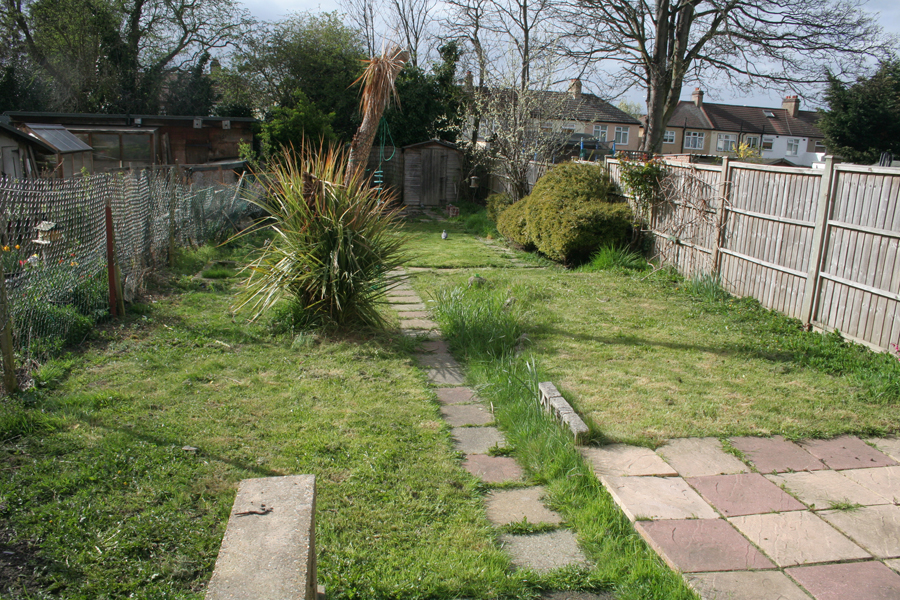
So back to our garden in Woodford. When looking at our shelter the first thing that struck me as odd was its placement. If you remove the slightly more modern Cordyline tree the shelter is slightly to one side but pretty much in the middle of the lawn, it actually looks like the path was put in later and works its way around the shelter.
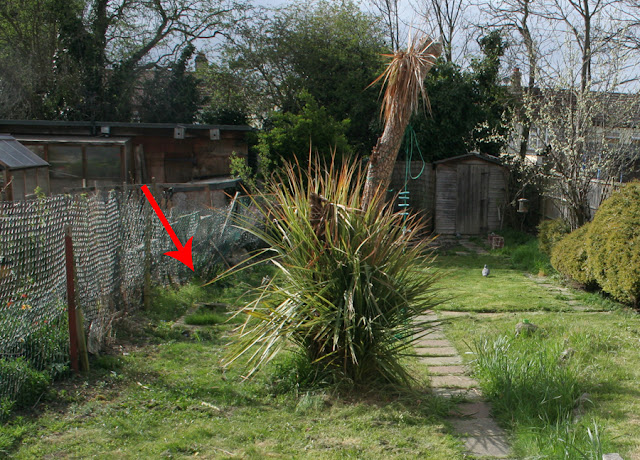
It's hiding behind the Cordyline tree in the middle of the lawn
While doing my research, I found a wonderful account on the BBC's WW2 Peoples War site by Brian Brooks who was a child during the war. Brian paints a vivid and humorous account of his families own shelter in Acton, which could offer an insight to why our shelter is located where it is.
"My Mum was angry because she had wanted the shelter put behind our shed and the apple tree, “out of the way as it will never be used”. There wasn’t enough room there, so she wanted it against the back fence. But the workmen discovered some buried lengths of pipe...the workmen simply dug their hole in the easiest place — destroying my Mum’s precious rockery. To add insult to injury they even used her rocks in the shelter’s concrete base! That Adolf Hitler had a lot to answer for, I wondered if he knew just how much trouble he was in?" [Source]
So perhaps our shelter was put where it is because it was the easiest place - far enough away from the house, to avoid too much damage if the house was hit, and also away from any of the pipe work and water mains that reside under the back of the house.  I know from speaking to Richard, that Ron who lived with his family in our house at the time, was serving in the army during the war, so perhaps it was installed for free by the council, as I wonder how many of the people who were building their own would have gone to the extra trouble and expenses of adding a concrete base!?
"As my Dad was serving in the army our shelter was free...our shelter, installed by the council, was just a tin box with a hole in it, in a hole in the ground — no door, weather or blast protection, not even a means of climbing down inside. The floor was concrete with a round dip sunk in one corner to collect moisture (!) and the sides were concrete up to three feet, ground level. Concrete was a rather grand name for what was little more than sand and water, I broke a piece off just by prodding it and was told off for ‘damaging’ the Air Raid Shelter! If I could damage it what would those Jerries do to it? If they dropped four-year-olds it didn’t look good. [Source]
It looks likely to me that ours was also installed by the councils workmen, though I must say the concrete base on ours is much more sturdy than Brian's, it's lasted over 70 years and is showing no signs of decay, I've accidentally blunted many a mower blade on it so far!

Another thing I found interesting, was just how small this shelter was, it's partly what made me question myself when finding it - it seemed too small!
The concrete base should go down about 4 ft.
When constructed the shelter would have been 6 ft high by 4 ft 6 in wide by 6 ft 6 in long. Obviously, it would have seemed a little bigger when it was standing, especially as the floor would have dropped down to about 4ft lower than now. But standing inside the filled in base you realise just how little space there is, and they were designed to accommodate six people!
"I finally got inside our shelter that seemed huge to me. But for grown-ups it was a struggle, hitting their heads on the sharp edges of the small entrance, and the sticking-out nuts and bolts everywhere." [Source]
My own Dad remembers one particular night with his Mum in his uncles Anderson shelter (they had a Morrison at home). It was so cramped with all the family in there that his Uncle had to sleep on the floor while he and his Mum shared the top bunk. During the night my Dad fidgeted just that bit too much on the narrow bed and proceeded to fall from the bunk landing (luckily for him) on to his soundly sleeping Uncle. Who on discovering this intruder to his slumber, let out a horrified yell, he must have thought that "Aay'dolf" had finally got him!

The Mackenzie family sitting during a raid in their Anderson shelter 1940 [Source]
That's 5 Adults, 2 Children, 1 Baby & 2 Dogs, all squeezed into this little shelter, it's making me feel claustrophobic!
As well as being cramped, it would have also been cold, dark and damp, not the most reassuring place to spend an air raid. So it's not then surprising that people wanted to do something make them little more bearable inside and out. The inside could be made nicer by adding beds and a few more creature comforts this video from Pathe News shows you how to make your shelter just a bit more comfortable Your Anderson Shelter in Winter.

On the outside, well you could be a touch more creative
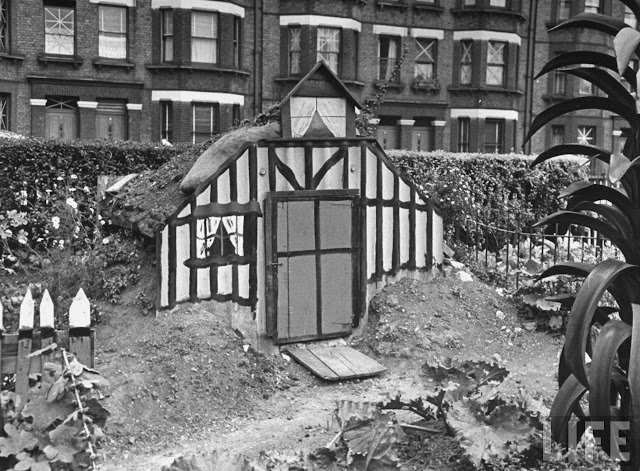
A well camouflaged Anderson shelter 1940 [Source
How wonderful it this shelter!
The earth banks that covered the shelter could easily be planted with vegetables and flowers, which must have made them look much more appealing sight, this lead to some neighbourhoods holding competitions to see who had the best-planted shelter in the area. Sounds wonderful!!  I have decided as an homage to the veg growing shelters of the past, I will dig out the grass and plant in some veggies (do I need more veggies, probably not, but that's not going to stop me!).

A lady tends to her rooftop crops [Source]
I know this is not exactly like finding a Roman hoard but to me it is just as interesting, if not perhaps quite as financially rewarding! Having lived in London all my life I've grown up seeing the evidence of the last war all around me, many streets show the signs of war damage by the various eras of houses built in them. My own street Carlton Road in Walthamstow, where I grew up and the same street where my Dad was born was hit by a doodlebug that killed 6 people, luckily my family were all safe, though my Nan recalled coming home to find the front door had been blown up onto the landing and looters in her home.

One thing I'm sure of, no matter how much I love this era in terms of its history and its fashion, there is no way I would want to have actually lived back then, I could never have handled a single night in an Anderson shelter, especially when knowing as many did, just how little protection they actually afforded, the people's courage back then has to be admired!
Wendy x

Sunday, 11 November 2012

Women In Wartime - MTC Girls For America

WW2 Women of the MTC
As it's remembrance Sunday today, I thought it would be appropriate to give you another one of my Picture Posts from the Imperial War Museums archive collection. Today we are going to follow Mrs. Pat Macleod and Miss Winifred Ashford as they go about their daily duties as part of the MTC.

Before we meet them I think a bit of history about the MTC wouldn't go amiss. I thought I would find loads of information about this service but to my surprise, there is actually very little to be found about the MTC online or in books. I know if it was not for the character of Sam Stewart in Foyle's War (ooh Just learnt there will be a series 8 airing in 2013!!!) many of us, me included would never have heard of them. 


So first a bit of History... The MTC or to give it is full name the Mechanised Transport Corps, was founded in 1939 by Mrs G.M Cooke CBE as a Women's Uniformed Voluntary Civilian Organisation, it was designed so that women who had family or other existing commitments, could still do their bit for the war effort by driving on a part-time basis.
Women of the MTC WW2 - Mrs. G Cooke OBE
Mrs. G.M.Cooke OBE
Image Taken from the War Relics Forum (Source)
All recruits underwent a three week intense Recruit's Training Course consisting of:
Vehicle Maintenance. - 16 hours minimum.
Map Reading. - 71/2 hours minimum.
Practical. - Stretcher Drill and Respirator Drill - 4 1/2 hours.
Special Lectures. - Gas, Driving and Breakdown Procedure, Convoy Driving, Duties of Drivers, Vehicle Inspection, Security.
Corps Lectures - To acquaint recruits with the administration of the Corps.
Squad Drill - Two periods daily.
Driving practice is given when necessary.
Further training is given, fortnightly or monthly in the unit or company to which the driver is posted. (Quote Source)

Once trained they would be posted to a unit/company and then be assigned to work as drivers for Several foreign governments, the Ministry of Agriculture, Health, Information and Supply and also for the Anglo-American Ambulance unit. Many also traveled abroad and were drivers in France, Egypt, Palestine, and Syria.

Women of the MTC - An MTC girl gets her orders from her superior on the bonnet of her car
Image Taken from the War Relics Forum (Source)
The most well-known members were the women who volunteered to drive ambulances in France at the beginning of the war as part of Hadfield-Spears Ambulance Unit. The girls who worked for Lady Spears became affectionately known as the "Spearettes".  Their endeavors did not go unnoticed by the French, it is said that the "petulant General de Gaulle peremptorily ordered the Hospital to be disbanded because the crowds at the Paris Victory Parade dared to cheer: 'Vive Spears!'" (Quote Source)

Unfortunately, there is no record of any girls from the MTC becoming police drivers, but that doesn't mean it couldn't have happened!

So back to our girls Pat and Winifred. It has taken a little detective work to figure out the story behind today's post . At first glance it would appear that the girls below are American and that's certainly what the archivist thought went typing up the descriptions, in fact, theses two girls are preparing to leave for America to create awareness and support for the people back home by telling their story of life working for the MTC in war-torn London.


Women of the MTC - Mrs Pat Macleod tightens a nut on the wheel of her ambulance as Miss Winifred Ashford looks on. The bonnet of the ambulance is open, ready for an inspection of the engine to be carried out. This photograph was probably taken at the depot in Paddington in 1940
Mrs. Pat Macleod tightens a nut on the wheel of her ambulance as Miss Winifred Ashford looks on. The bonnet of the ambulance is open, ready for an inspection of the engine to be carried out. This photograph was probably taken at the depot in Paddington in 1940.

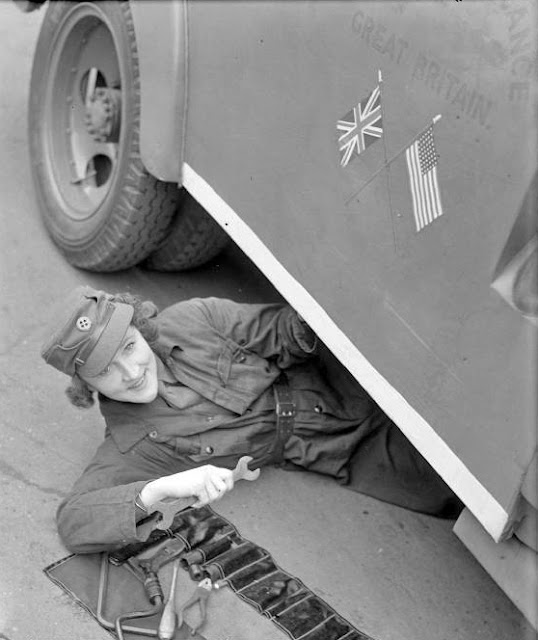
Women of the WW2 MTC - Mrs Pat Macleod slides out from under the ambulance she is repairing to smile for the camera. She is doing maintenance work on ambulance 8, which was presented by Elliott Nugent Esq. through the American Field Service.
Mrs. Pat Macleod slides out from under the ambulance she is repairing to smile for the camera. She is doing maintenance work on ambulance 8, which was presented by Elliott Nugent Esq. through the American Field Service.

 The depot is probably somewhere in Paddington in London. Painted on the side of the vehicle are the British and American flags, confirming that this ambulance is part of the American Ambulance, Great Britain.

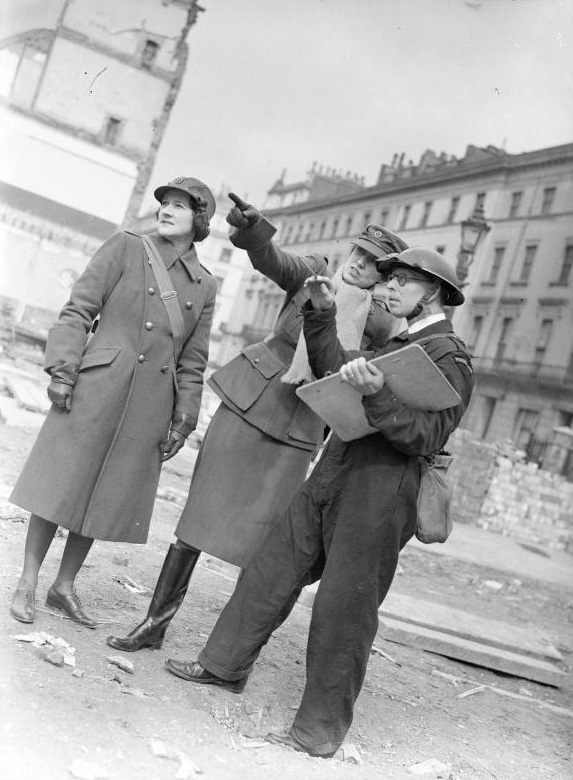
Women of the WW2 MTC - Miss Winifred Ashford points something out to an Air Raid Precautions (ARP) Warden with a clipboard, as Mrs Pat Macleod looks on. The Warden is based at Paddington ARP station. Behind them can be seen an empty space that once held houses before they were destroyed in an air raid.
Miss Winifred Ashford points something out to an Air Raid Precautions (ARP) Warden with a clipboard, as Mrs. Pat Macleod looks on. The Warden is based at Paddington ARP station. Behind them can be seen an empty space that once held houses before they were destroyed in an air raid.

Women of the MTC - Miss Winifred Ashford and Mrs Pat Macleod open up their mobile canteen in front of a pile of rubble and some severely bomb-damaged houses, London, 1940.
Miss Winifred Ashford and Mrs Pat Macleod open up their mobile canteen in front of a pile of rubble and some severely bomb-damaged houses, London, 1940.

Women of the WW2 - Miss Winifred Ashford, Mrs Pat Macleod and other women of the MTC join men of the Pioneer Corps as they make toast over a fire built of timbers extracted from the rubble of this bomb-damaged area. This photograph was probably taken on Barrie Street, Paddington and the church which is visible behind the group of people is probably St. James's Church. The car which pulls the mobile canteen run by Miss Ashford and Mrs Macleod is parked outside the church.
Miss Winifred Ashford, Mrs Pat Macleod and other women of the MTC join men of the Pioneer Corps as they make toast over a fire built of timbers extracted from the rubble of this bomb-damaged area. This photograph was probably taken on Barrie Street, Paddington and the church which is visible behind the group of people is probably St. James's Church. The car which pulls the mobile canteen run by Miss Ashford and Mrs Macleod is parked outside the church.

Women In Wartime - MTC Girls For America
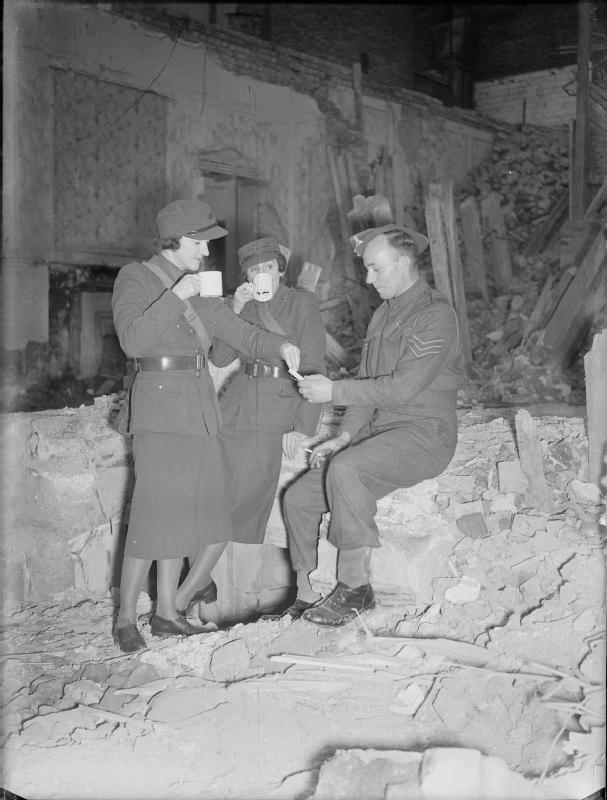
Mrs Pat Macleod accepts a cigarette from a member of the Pioneer Corps as she and Miss Winifred Ashford enjoy a cup of tea, somewhere in London. They are resting on a large pile of rubble. Behind them, more rubble and timbers can be seen, and also visible is the interior wall of the house which once stood on this site.

Women of WW2 MTC - Miss Winifred Ashford and Mrs Pat Macleod enjoy a cup of tea beside their mobile canteen amongst rubble and other debris. In the background, St. James's Church, Paddington, can be seen. The spire of the church is shrouded in scaffolding, as it was badly damaged in an air raid.
Miss Winifred Ashford and Mrs Pat Macleod enjoy a cup of tea beside their mobile canteen amongst rubble and other debris. In the background, St. James's Church, Paddington, can be seen. The spire of the church is shrouded in scaffolding, as it was badly damaged in an air raid.

Women of the MTC WW2 - Mrs Pat Macleod and Mrs Winifred Ashford chat to a policeman as they wash up in the back of their mobile canteen, somewhere in London, 1940. A church, possibly St James's Church, Paddington, can just be seen in the background.
Mrs Pat Macleod and Mrs Winifred Ashford chat to a policeman as they wash up in the back of their mobile canteen, somewhere in London, 1940. A church, possibly St James's Church, Paddington, can just be seen in the background.
Women In Wartime - MTC Girls For America
Miss Winifred Ashford, Mrs Pat Macleod and a helper from the Pioneer Corps shut up the mobile canteen after supplying refreshments to men of the Pioneer Corps who have been clearing up bomb damage. Behind the canteen, the damaged houses can be clearly seen: three men of the Pioneer Corps can be seen on an upper floor. Also visible are the ARP car which tows the canteen and another car, parked behind the canteen.


Women In Wartime - MTC Girls For America
In the rest room at their depot, Miss Winifred Ashford, Mrs Pat Macleod and other members of the Mechanised Transport Corps relax. Seated in front of the fireplace, Miss Ashford reads a newspaper and Mrs Macleod mends an item of clothing whilst their colleagues smoke and play with the depot's kitten. Can you spot the dog?

Women In Wartime - MTC Girls For America
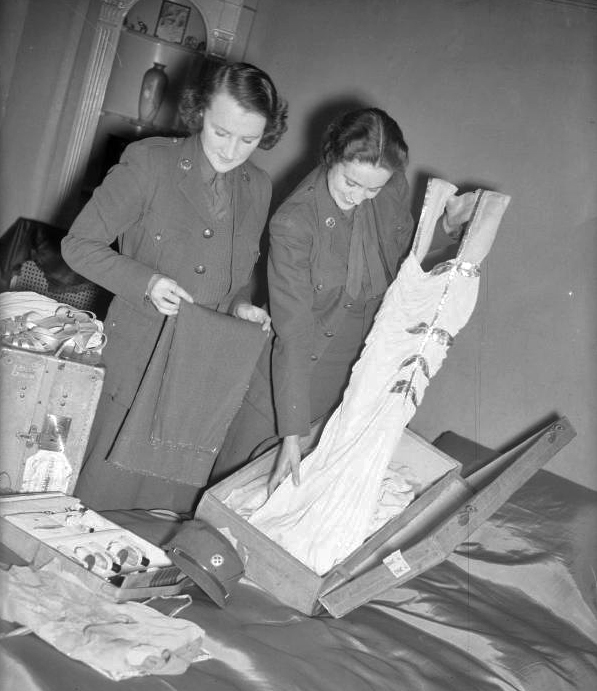
Mrs Pat Macleod and Miss Winifred Ashford pack their suitcases for departure. It is unclear whether this is their departure from America to Britain, or from a depot to another posting elsewhere in Britain.

Initially, I struggled to find any information at all on these two ladies - It is always much harder to find the women than the chaps as they tend to get married and change their names. Frustrating! But then I stumbled across some articles on Google's Newspaper database dating from 1941, which I have transcribed below, they offer a fascinating insight into daily life of the MTC.

The first article gives us a bit of background on these two women and explains exactly what they were up to while visiting America.

Mobile Feeding Unit Here For Tour Of City Today
Two British Women, Veterans Of Service Under London Bombing, To Demonstrate War Work
---Will Show Film.
Miss Winfred Ashford and Mrs. Pat Macleod, ace drivers of the Mechanized Transport Corps of England, will tour Meriden today with a Mobile feeding Unit similar to that the Meriden chapter of the British war relief society is maintaining in war-torn Britain.

These women who will give Meriden residents first-hand information concerning their war work will appear in Crown Street Square at 11:30a.m. until 12:30p.m. in front of the NEW Departure plant on Pratt Street at 2:45p.m. in front of factory E, International Silver company, on State Street at 4:45 p.m. and in front of city Hall auditorium at 7:15p.m.

Film at City Hall
At 8:15 they will show a sound moving picture taken under the "Blitz" in London "Thumbs Up" in the city Hall auditorium. There will be no charge of any kind and the public is cordially invited.

Miss Ashford, a dress designer before the war, volunteered for service during the Munich crisis. Her establishment in Bond street, London was bombed out during the "Blitz" she has done night duty without a break since the outbreak of war in the greatly bombed dock area of London.

Mrs. Macleod comes from Dover, England. Before the war she travelled widely and has done big game shooting in the Kalahari Desert. She has frequently fed as many as 300 people in a night when she had been on duty with the Mobile Feeding Unit and has done fire duty as well.

Both these women have survived the worst of London's bombing, exhibiting great bravery and cool heads in the midst of violent action.

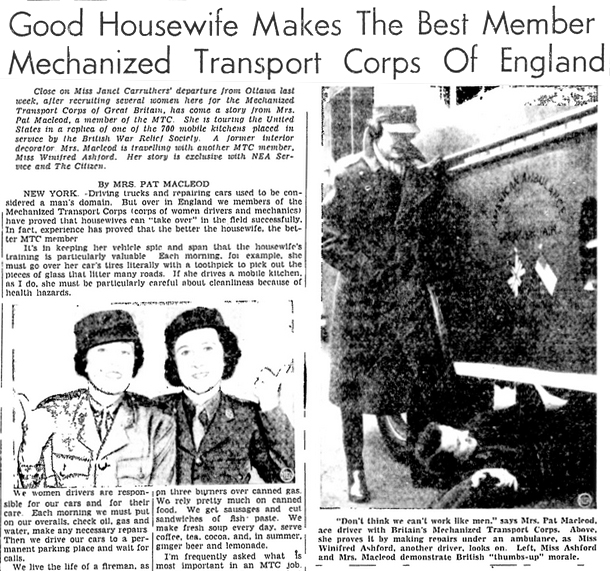
The second article which can be found in a few publications has been written by Pat Macleod, Now it is quite long but it gives us a great insight into exactly what these women were facing on a daily basis.

'Good Housewife Makes the Best Member Of The Mechanised Transport Corps Of England'
By Mrs Pat Macleod
NEW YORK - Driving trucks and repairing cars used to be considered a man's domain. But over in England we members of the Mechanized Transport Corps (a corps of women drivers and mechanics) have proved that the better the housewife, the better MTC member. 
It's in keeping her vehicle spick and span that the housewife's training is particularly valuable. Each morning for example, she must go over her car's tires literally with a tooth pick to pick out the pieces of glass that litter many roads. If she drives a mobile kitchen, as I do, she must be particularly careful about cleanliness because of health hazards. 
We women drivers are responsible for our care and for their care. Each morning we must put on our overalls, check oil, gas and water, make any necessary repairs. Then we drive our car to a permanent parking place and wait for calls. 
We live the life of a fireman as far as hours are concerned - often working 12 to 24 hours straight. Once I did 36 hours at a stretch during the big London fire in December. And during the period when we are working, we are constantly on call. Its hard work - tough work. With hours that sometimes seem like days. There's no gainsaying that But by this time everyone knows that Englishwomen can take it. It was easier for me than for some others perhaps, because I had volunteered at the French Military Hospital in Biarritz during the last war and had seen six months service as an ambulance driver. 
EACH CALL IS AN 'INCIDENT'
When this war began I enlisted in the MTC and since have driven almost every kind of wartime vehicle under almost every circumstance and condition. Now with the mobile kitchen unit, I go about feeding thousands who pack shelters, those who lie wounded in air raid ruins or those who keep on bravely living in the skeletons of dwellings they call homes.
The car we use is a three piece trailer affair - a sedan pulling two trailers. The vehicle as a whole weighs three tons.
 
I have an assistant - a paid air-raid precautions worker, and a district to cover - Paddington allied with military objectives such as gas works railroad terminals, power stations, ammunition dumps.
Each call we make is called an 'incident' which seems to amuse Americans. An 'Incident' is undertaken usually about a half hour after the raid call sounds. The depot department may report: "Causalities are heavy - better take enough for 400 people". I drive to a place where most people are likely to be gathered - frequently under direct bombing attack. 
Then when the shrapnel has ceased beating a tune on my tin hat, I set up shop. Queues form, and I serve food. It's wholesome food, but nothing elaborate, for we cook on three burners over canned gas. We rely pretty much on canned food. We get sausages and cut sandwiches of fish paste. We make fresh soup every day, serve coffee, tea, cocoa and in summer gingerbread and lemonade. 
MAPS ARE VITAL I'm frequently asked what is most important in an MTC job. In my opinion it's maps - just plain everyday street maps - and that surprises most people. But consider when the call comes in the dead of night and you set out for a given destination, all is pitch dark. The black out is on. You cannot see your streets and alleys. you must know them. You must have memorised each landmark and remember where the bombs have fallen and the streets are filled with great holes. And that is nor enough - you must have the last minute word on this. Even as you leave, a shell hole may have appeared on a new place and you drive in to certain destruction unless last minute checks are made by phone and radio. Sometimes your travels become circuitous. But in your first training, maps are fairly banged into your head. MTC members undergo a very strenuous three-week training course during which you learn map reading, car maintenance, convoy driving, first-aid, gas precaution and drill for two hours every day. 
Someone usually asks me: Can the women stand it? Can they and how, as Americans say. More than ninety percent of the London women can take it and fit in to some picture or other: just as we MTC members have fitted into our jobs somehow, you begin to forget danger, just want to get where your going and help. Bravery is probably catching. when you see bombed babies, when you view the blast remains of historic landmarks your people have been proud of for centuries past, it's easy to take repairing a car with grease on your hands and in your hair. British women can take it, as the members of the MTC prove. We have been called brave - if we are, it's because we have caught it, from the staunch, heroic citizenry we serve.
I think you'll agree the girls of the MTC were very courageous women, especially considering during much of the war (until the Ministry of War Transport eventually recognised it) they were volunteers who received no pay. As little can be found online about the women of the MTC, I hope this post will go away to help them not be forgotten.


If you enjoyed this post you can read more about women of the MTC below, or if you fancy looking through some my past Picture Posts click the tab at the top!

Further Reading:
Wendy x
Sunday, 30 September 2012

Women in Wartime - War Bride

Hello, I've got another instalment from the Imperial War Museums Collection Archive for you all today, I do hope you are enjoying these as much as I enjoy piecing the stories back together, it's addictive!

So today we have the story of newly engaged couple Marcelle and Harold as they go about their preparations for their upcoming nuptials in March 1943.
A head and shoulders portrait of newly-engaged couple Miss Marcelle L'estrange and Flying Officer Harold Lackland Bevan on a street in London.
Newly-engaged Marcelle L'estrange and her fiance Flying Officer Harold Lackland Bevan look in a jeweller's shop window for a suitable engagement and/or wedding ring. 
Because of the scarcity of gold and jewels, jewellers are only allowed to sell a certain quota of jewels each quarter, many selling out at the very beginning of the quarter. Gold had been stopped for wedding ring manufacture, but is now released in small quantities, but gold wedding rings are very hard to find, particularly in the cities.
Marcelle L'estrange and Harold Lackland Bevan examine an engagement ring in a jeweller's shop in London. There is little choice, as restrictions, precious metals such as gold and the lack of skilled staff to re-set rings means that couples like Marcelle and Harold must choose for the remainder of pre-war stock.
Harold Lackland Bevan and Marcelle L'estrange examine some pieces of secondhand china in a shop in London. All china now being produced in Utility and plain white. Coloured china sets have disappeared with the exception of some remaining pre-war stocks of Crown Derby and Coleport. Secondhand dinner services are therefore in huge demand.
Marcelle L'estrange looks at a wedding cake in a shop in London. The assistant explains that the icing effect is made of painted cardboard and rice paper and lifts off to reveal the real cake below. According to the original caption: "The cake underneath the trimmings is less full of currants than a pre-war cake and must not cost more than 35 cents a pound".
Marcelle L'estrange stops to buy some cleaning products from a kiosk on her way home. A blackboard lists various products and their uses, such as 'Texacleen' for 'silks, rayons and woollens', and buckets and the like are stacked in the open air. 
Newly-engaged Marcelle L'estrange buys vegetable seeds from a salesman in London. Civilians are encouraged, through the 'Dig for Victory' campaign, to grow their own vegetables anywhere they can, so even if they do not have a garden, a window box should be used instead.
Marcelle L'estrange looks at her permit for Utility furniture which she has just received from Chelsea Borough Council in March 1943

How amazing is Marcelle's Hair!! the is certainly some authentic Victory rolls going on there, well when you are engaged to a Chap in the RAF it's only fitting!!
Marcelle L'estrange fills in an application form for Utility furniture. Identity card numbers, full names, addresses and occupations of the people applying for this furniture must be given, along with the reasons for purchase and the possible amount required.
Marcelle L'estrange looks through a catalogue of Utility furniture in a shop in London. Although there is not much choice, the furniture is simple and practical and all articles are sold at a controlled rate, free of purchase tax, making it a lot cheaper for young couples setting up home for the first time.
Flying Officer Harold Lackland Bevan buys some daffodils for his bride-to-be from a flower seller in Sloane Square, Chelsea.
All images and Quoted text are taken from the Imperial War Museum Collection Archive


Sadly we don't get to see Harold and Marcelle's wedding (Boo!) but I am sure it was a wonderful day even with the cardboard icing on the cake!


In November of the same year, shortly after these pictures were taken, Harold was awarded the Distinguished Flying Cross for his work as a bomb aimer and Visual marker flying in Lancaster's, with 165 Squadron. He continued flying many sorties right up to the end of the war. 

After a fair bit of searching, I finally found both of their names (Marcelle was nicknamed Tessa) amongst those of the passengers aboard the Aquila Airways 'City of Sydney' traveling to Palermo on the 15th Nov 1957. This was an ill-fated voyage. Due to problems with one of its propellers, the pilot made the decision to return to Southampton airport, during this attempt it crashed into a chalk pit on the Isle of Wight. Out of the 58 passengers and crew, only 13 survived, Harold and Tessa were not among them.
"With over 50 people on-board the craft appeared to loose power rapidly and crash into the disused chalk pit just above the small villages of Chessell and Shalcombe. Sadly the crash took the lives of 43 of the passengers and crew, valiant efforts were made by locals including that of the Author JB Priestly and a local policeman but before they could assist anymore passengers or crew the aircraft burst into flames and anyone left in the plane sadly perished."           (Quote source)
I can't help feeling a sad irony to their story, to survive all those potentially dangerous missions over Germany and the bombing of London and then to be killed on a holiday flight. They would have been married for about 13/14 years, I do hope they were happy.


If you enjoyed this then you might fancy looking through some my past Picture Posts click the tab at the top!

Wendy x